
In 2023, the world was introduced to a new kind of technology. People asked questions, generated essays, wrote code, translated languages, and created artwork with a few lines of text. The rapid adoption of generative artificial intelligence convinced many that we were witnessing one of the most significant technological shifts since the arrival of the internet. Yet, only a few years later, it is becoming increasingly clear that generative AI was not the destination. It was merely the beginning.
A new technological paradigm is emerging, one that extends far beyond conversational interfaces and text generation. Researchers, technology companies, and policymakers are now focusing their attention on AI agents—systems capable of planning, reasoning, making decisions, and executing complex tasks with minimal human intervention. While chatbots respond to requests, AI agents pursue objectives. This distinction may appear subtle, but it represents one of the most important developments in the history of computing.
For decades, software has operated according to explicit instructions. Whether using a spreadsheet, a search engine, or an enterprise application, humans remained responsible for defining every step required to complete a task. The software performed calculations and stored information, but decision-making largely remained in human hands. AI agents challenge this long-standing model. Instead of telling a system exactly what to do, users can increasingly specify what they want to achieve. The agent determines how to accomplish the objective.
Imagine asking a digital system to prepare a comprehensive market analysis for a new business opportunity. A traditional application would require the user to collect data, organize information, perform analysis, create visualizations, and write the final report. An AI agent approaches the problem differently. It can search for relevant information, identify reliable sources, analyze trends, summarize findings, generate charts, and assemble a professional report while continuously evaluating the quality of its output. The user shifts from being an operator of software to a supervisor of intelligent processes.
This transformation is possible because recent advances in artificial intelligence have moved beyond simple prediction and content generation. Modern AI systems are increasingly capable of combining reasoning, memory, planning, and tool usage within a single framework. Rather than producing isolated answers, they can maintain long-term goals, adapt to changing circumstances, and interact with external systems. In many ways, AI agents resemble digital employees more than traditional software applications. The significance of this development becomes clearer when viewed through the lens of economic history. Every major technological revolution has automated a particular form of human effort.
AI Is Already Mainstream Before AI Agents Become Mainstream
The rise of AI agents is not occurring in isolation. Organizations worldwide have spent the last few years integrating artificial intelligence into business operations, customer service, software development, marketing, and decision-making processes. This widespread adoption provides the foundation upon which autonomous AI agents are now being built. Before discussing the future impact of AI agents, it is important to recognize how rapidly AI itself has become embedded within modern organizations.
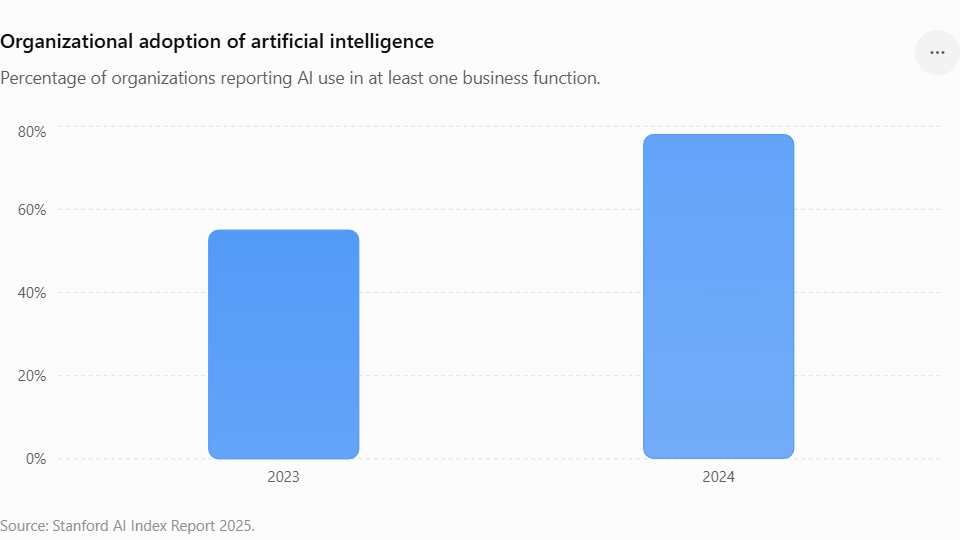
Figure 1. Percentage of organizations reporting AI use in at least one business function. Adoption increased from 55% in 2023 to 78% in 2024, reflecting the rapid integration of AI technologies across industries.
Source: Stanford Institute for Human-Centered Artificial Intelligence, AI Index Report 2025, Chapter 4 (Business and Enterprise Adoption).
Before discussing why AI agents may transform knowledge work, it is worth examining how quickly artificial intelligence has already entered mainstream business operations. According to the Stanford AI Index Report 2025, organizational AI adoption increased dramatically within a single year, highlighting the growing willingness of enterprises to integrate AI into core business functions. AI agents are emerging within this broader wave of enterprise AI adoption rather than as an isolated technological trend.
The Industrial Revolution mechanized physical labor. The Information Age automated calculations and information processing. The emerging era of AI agents aims to automate portions of knowledge work itself. Activities that once required extensive human coordination, such as research, analysis, scheduling, documentation, compliance monitoring, and software development, are increasingly being supported by autonomous systems capable of operating across multiple platforms simultaneously.
This does not mean that human expertise is becoming obsolete. In fact, the opposite may be true. As AI systems become more capable of executing routine intellectual tasks, uniquely human capabilities become increasingly valuable. Critical thinking, ethical judgment, strategic reasoning, creativity, and emotional intelligence remain difficult to replicate through computational methods. The future workplace is unlikely to be defined by humans competing against AI. Instead, it will be characterized by collaboration between human expertise and machine intelligence.
One of the most fascinating aspects of AI agents is their ability to function as part of larger ecosystems. Researchers are increasingly exploring multi-agent systems in which specialized agents collaborate to achieve complex objectives. A research agent may gather information, an analytical agent may interpret data, a writing agent may draft reports, and a review agent may verify accuracy and compliance requirements. Together, these systems operate as coordinated digital teams capable of performing tasks that would have previously required entire departments.
The implications extend far beyond business productivity. In healthcare, AI agents are beginning to assist clinicians by analyzing patient records, identifying patterns, and recommending treatment options based on current medical evidence. In scientific research, agents can rapidly review thousands of publications, helping researchers navigate the growing volume of academic literature. In cybersecurity, autonomous systems continuously monitor networks, investigate anomalies, and respond to emerging threats at speeds impossible for human analysts alone. These applications suggest that AI agents may become foundational infrastructure across nearly every sector of society.
Despite their promise, however, AI agents introduce challenges that cannot be ignored. The same autonomy that makes these systems valuable also creates new risks. An agent that makes an incorrect assumption may propagate errors across an entire workflow. Systems capable of accessing multiple databases and applications may introduce cybersecurity vulnerabilities if not properly governed. Questions surrounding accountability become increasingly complex when decisions emerge from interactions among multiple autonomous systems rather than from a single human decision-maker.
These concerns are driving global discussions regarding AI governance and regulation. Governments, international organizations, and technology companies are working to establish frameworks that balance innovation with accountability. The challenge is particularly significant because AI agents blur traditional boundaries between software tools and decision-making entities. Determining responsibility for errors, ensuring transparency, protecting privacy, and maintaining meaningful human oversight are becoming central issues in technology policy debates worldwide.
The rise of AI agents also aligns closely with the broader vision of Industry 5.0, which emphasizes human-centered technological development. Unlike earlier waves of automation that focused primarily on efficiency and productivity, Industry 5.0 seeks to create collaborative environments where intelligent technologies enhance human capabilities rather than replace them. Within this framework, AI agents are not viewed as substitutes for human workers but as partners that augment expertise, reduce cognitive burden, and enable individuals to focus on higher-value activities.
Looking ahead, the impact of AI agents may prove even more profound than the initial wave of generative AI applications. The first generation of AI systems transformed how people create content. The next generation is transforming how work itself is performed. As these technologies mature, the distinction between software and workforce may gradually begin to disappear. Organizations will increasingly manage ecosystems composed of both human employees and autonomous digital agents, each contributing unique strengths to shared objectives.
History suggests that transformative technologies often appear incremental at first. The internet began as a communication network before reshaping commerce, media, education, and society itself. Similarly, AI agents may initially seem like advanced productivity tools. Yet their ability to plan, reason, adapt, and act autonomously represents a fundamental departure from traditional computing models. They are not simply helping people use technology more effectively; they are changing the very nature of the relationship between humans and machines.
The coming decade will likely be remembered as the period when artificial intelligence evolved from a system that generated answers into a system capable of pursuing goals. Whether this transformation ultimately benefits society will depend not only on technological advancement but also on the wisdom with which these systems are designed, governed, and integrated into human institutions. The future of artificial intelligence is no longer solely about making machines smarter. It is about determining how increasingly autonomous systems can serve human values in an increasingly digital world.
As the age of AI agents begins, the most important question is not what machines can do for us, but how humanity chooses to work alongside them.
No responses yet